Web designing in a powerful way of just not an only professions. We have tendency to believe the idea that smart looking .

Foundation of power

Explore about Foundation of power

Foundation of power

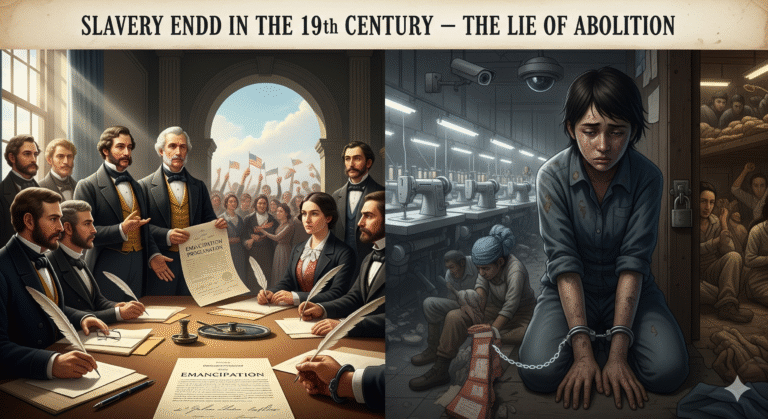
Slavery Ended in the 19th Century – The Lie of Abolition

History books claim slavery ended in the 19th century with Britain’s 1833 Act and America’s 1865 Amendment. But slavery never ended—it simply changed its form. Africans were “freed” only to face forced apprenticeships. In the U.S., the prison labor loophole kept African Americans enslaved. In colonies, millions of Indians were shipped as indentured laborers to sugar and tea plantations across the Caribbean, Fiji, Mauritius, and Africa—living lives no different from slaves. Colonial rule itself was slavery without chains: industries destroyed, resources drained, farmers starved. Today, slavery still exists as bonded labor, child exploitation, human trafficking, and corporate sweatshops. The West glorifies itself as an abolitionist hero while hiding the truth: slavery was globalized, not abolished. True freedom will come only when dignity is placed above profit. Until then, the claim that slavery ended in the 19th century remains one of history’s greatest lies.

Foundation of power

Empires Fell and Freedom Came – The Lie of Decolonization

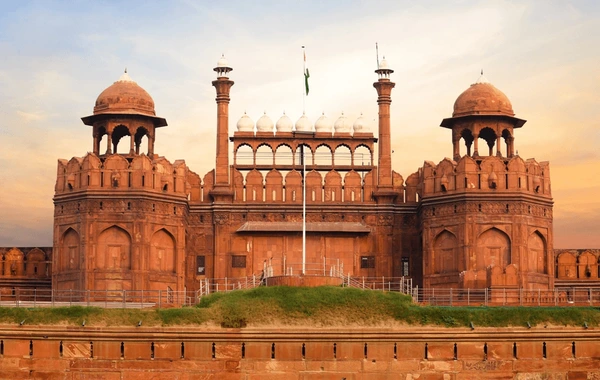
Textbooks glorify the mid-20th century as the “end of empire.” Nations across Asia and Africa raised new flags, declared independence, and celebrated freedom. But true sovereignty never came. Colonial rulers simply shifted to neo-colonialism—economic dependency, debt slavery, corporate exploitation, military control, and cultural dominance. In India, partition ensured weakness and division. In Africa, mines and oilfields stayed in foreign hands while resistant leaders were assassinated. The IMF, World Bank, and U.S. dollar created financial empires without armies. Hollywood, English, and Western consumerism colonized minds long after flags were changed. Independence days became symbolic ceremonies while exploitation continued. Real freedom is not in changing rulers but in breaking economic chains, reviving culture, and reclaiming sovereignty of mind and spirit. Until then, the belief that “Empires fell and freedom came” remains one of the greatest lies of modern history.

Foundation of power

We Live in a Free Market – The Lie of Economic Freedom

We are told we live in a “free market,” where competition and choice bring prosperity. But the truth is, no market is free. Entire industries are dominated by a handful of corporations—tech by Google and Amazon, agriculture by Monsanto, pharma by a few giants. Governments constantly intervene through subsidies, bailouts, wars, and regulations favoring elites. India’s so-called liberalization opened doors to foreign corporations while farmers and artisans collapsed. Globally, IMF, World Bank, and WTO enforce rules that trap nations in debt and dependency. Markets are further manipulated by central banks, speculators, and cartels. The beneficiaries? Corporations, governments, and financial elites. The common man faces inflation, debt, and job insecurity. Real freedom lies in self-reliance, breaking monopolies, and dharmic economics that values people above profit. Until then, the “free market” remains one of history’s most profitable lies.

Letter to Fellow Citizen

Explore about Letter to Fellow Citizen

Letter to Fellow Citizen

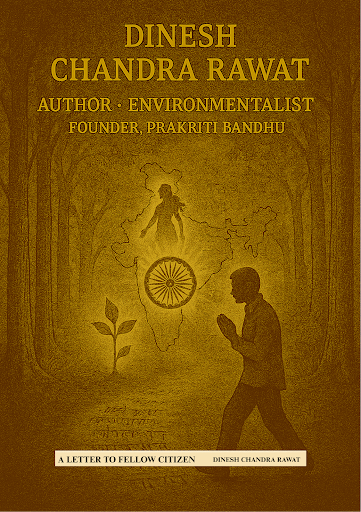
ABOUT THE AUTHOR

Dinesh Chandra Rawat is a visionary creator, environmentalist, meditator, and researcher. He is the founder of Prakriti Bandhu, Green Mall, and the Glories of India movement—initiatives that blend ecological service, cultural revival, and civilizational education.
A former director in over 20 companies, Dinesh has traveled to more than 60 countries, studying landscapes, cultures, and ecological practices. His work spans landscape architecture, symbolic design, legal advocacy, and movement-building. He is known for his ability to synthesize ancient wisdom with modern strategy—whether through gardens, books, or campaigns.
Dinesh’s writing is poetic, investigative, and transformative. His outreach spans multiple languages and platforms, always rooted in reverence for Bharat Mata and the dharmic worldview. He believes that education must awaken pride, ecology must be sacred, and history must be told truthfully.
This book is his offering to the nation—a call to remember, rebuild, and rise.

Letter to Fellow Citizen

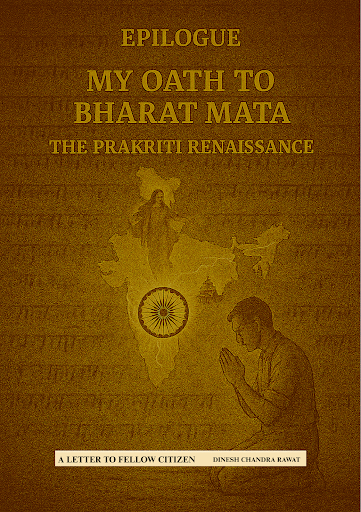
EPILOGUE
MY OATH TO BHARAT MATA

This epilogue is a personal and civilizational vow. The author reflects on the journey through 27 chapters—each revealing a distortion, a truth, and a call. Now, he offers his oath to Bharat Mata, the sacred embodiment of India’s soul.
He pledges to speak truth, restore memory, and serve dharma. He calls upon every reader to take their own oath—not just in words, but in action. To protect the soil, the rivers, the temples, the children, the elders, and the stories. To rise not with anger, but with clarity and courage.
This is not just a conclusion—it is a beginning. A movement. A prayer. A promise

Letter to Fellow Citizen

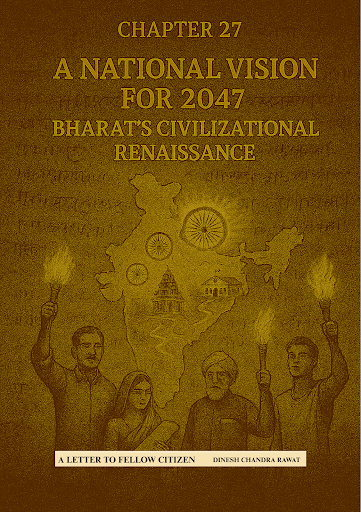
CHAPTER 27
A NATIONAL VISION FOR 2047 — BHARAT’S CIVILIZATIONAL RENAISSANCE

This chapter presents a transformative vision for India’s centenary of independence in 2047—not just as a developed nation, but as a civilizational beacon. The author outlines a roadmap for Bharat’s renaissance rooted in dharma, truth, ecology, and cultural confidence.
He calls for:
Truthful education that restores historical memory and indigenous knowledge
Dharmic governance that prioritizes justice, decentralization, and spiritual ethics
Ecological revival through sacred stewardship of land, water, and biodiversity
Cultural resurgence in language, art, architecture, and festivals
Global leadership in spiritual science, non-violence, and civilizational dialogue
The chapter emphasizes that this vision must rise from citizens—not just governments. It is a call to artists, educators, entrepreneurs, and seekers to build a Bharat that is materially strong and spiritually luminous.
This is not a utopia. It is a possibility. And it begins now.

Letter to Fellow Citizen

CHAPTER 26
BHARAT’S ENVIRONMENTAL DHARMA — THE PRAKRITI PATH

This chapter reclaims India’s ancient ecological wisdom, rooted in dharma and reverence for nature. The author introduces the concept of the Prakriti Path—a civilizational approach to living in harmony with the earth, where rivers are mothers, trees are sages, and soil is sacred.
He contrasts this with the colonial and industrial view of nature as a resource to be exploited. The chapter explores how dharmic traditions—from Vedic texts to tribal customs—honored biodiversity, seasonal rhythms, and ecological balance. It also critiques modern environmentalism for being disconnected from cultural memory and spiritual depth.
The author calls for a revival of environmental dharma—not just through laws, but through lifestyle, education, and community rituals. He shares examples of sacred groves, water-harvesting traditions, and plant-based festivals that once sustained Bharat’s ecological soul.
This chapter is a prayer and a plan. It asks: can we walk the Prakriti Path again?

Letter to Fellow Citizen

CHAPTER 25
MY APPEAL TO MY FELLOW CITIZENS — A CALL TO RISE FOR MOTHER INDIA

This final chapter is a heartfelt appeal to every Indian citizen. The author reflects on the journey through history, distortion, and awakening—and calls upon readers to become torchbearers of truth. It is not enough to know. We must act.
He urges citizens to reclaim India’s civilizational memory, restore dharmic values in education, governance, and culture, and build movements rooted in pride, ecology, and spiritual clarity. The chapter emphasizes that Bharat’s revival will not come from governments alone—it must rise from the people.
This is a call to students, teachers, parents, activists, artists, and seekers. To rise with knowledge, courage, and compassion. To speak truth. To build anew. To honor the ancestors and protect the future.
This chapter is not an ending—it is a beginning. A manifesto for civilizational renaissance.

Letter to Fellow Citizen

CHAPTER 24
THE NEED FOR A NEW SYLLABUS — RESTORING TRUTH, CONTINUITY & CULTURAL CONFIDENCE

This chapter builds on the critique of colonial education and offers a bold vision for a new syllabus rooted in Bharat’s civilizational genius. The author argues that India’s current curriculum still reflects colonial priorities—Eurocentric history, disconnected science, and a neglect of dharma, ecology, and indigenous knowledge systems.
He proposes a new framework for education that restores historical truth, celebrates cultural continuity, and builds confidence in India’s philosophical, scientific, and artistic legacy. The chapter outlines key themes that must be included: ancient technologies, spiritual ecology, dharmic ethics, real history, and regional diversity.
It also emphasizes the need for multilingual, experiential, and emotionally resonant learning—where students connect with their land, their ancestors, and their purpose. The goal is not nostalgia—it is empowerment.
This chapter is a blueprint for civilizational renewal. It asks: what kind of minds are we shaping—and for whose future?

Letter to Fellow Citizen

CHAPTER 23
THE COLONIAL EDUCATION SYSTEM — A MACHINE BUILT TO BREAK INDIA’S SOUL

This chapter reveals how the British education system in India was engineered to dismantle civilizational pride and produce obedient servants of empire. The author traces how Macaulay’s infamous Minute on Indian Education replaced Sanskrit, philosophy, and dharma with English, rote learning, and colonial ideology.
He explores how this system trained generations to forget their roots, ridicule their own culture, and seek validation from foreign models. Even after independence, the structure remained largely unchanged—alien syllabi, outdated pedagogy, and a deep disconnect from India’s spiritual and ecological genius.
The chapter calls for a radical reimagining of Indian education—one that restores pride, revives indigenous knowledge systems, and prepares students to serve dharma, not empire.
This chapter is a mirror and a manifesto. It asks: what are we teaching our children—and why?

Letter to Fellow Citizen

CHAPTER 22
THE COLONIAL LEGAL SYSTEM — THE EMPIRE NEVER LEFT

This chapter exposes how India’s legal system remains deeply colonial in structure, spirit, and language. The author traces how British laws, procedures, and institutions were transplanted into India—not to deliver justice, but to control subjects. Even after independence, these systems were retained with minimal reform.
He critiques the use of archaic English, Latin phrases, and complex procedures that alienate ordinary citizens. He highlights how colonial logic—punitive, bureaucratic, and disconnected from dharma—still dominates courtrooms, legislation, and legal education.
The chapter also explores India’s ancient legal traditions—rooted in dharma, community, and restorative justice—and calls for their revival. It’s not just about changing laws—it’s about changing the soul of justice.
This chapter is a wake-up call: freedom must reach the courtroom. Bharat must decolonize its legal mind.

Letter to Fellow Citizen

CHAPTER 21
THE NATIONAL ANTHEM — A COLONIAL SHADOW STILL ECHOING IN FREE INDIA

This chapter critically examines the origins of India’s national anthem, “Jana Gana Mana,” and the historical context in which it was composed. The author presents evidence that the song was written to honor the British monarch George V during his visit to India in 1911, and questions how such a composition became the anthem of a free nation.
He explores the political pressures, cultural confusion, and ideological compromises that led to its adoption—despite alternative compositions like “Vande Mataram” that were deeply rooted in India’s freedom struggle and civilizational ethos.
The chapter also reflects on the psychological impact of retaining colonial-era symbols and narratives, and how they subtly shape national identity. It calls for a civilizational reawakening—where Bharat sings with its own voice, not one borrowed from imperial flattery.
This chapter is not just about a song—it’s about sovereignty, memory, and the courage to choose truth over tradition.

Letter to Fellow Citizen

CHAPTER 20
INDIAN ARCHITECTURE — THE WORLD’S GREATEST CIVILIZATIONAL SIGNATURE REWRITTEN BY FORCE

This chapter explores the profound genius of Indian architecture—and how it was systematically misrepresented under foreign rule. The author reveals how temples, stepwells, mandapas, and stambhas were designed with cosmic precision, ecological harmony, and spiritual symbolism. These were not just buildings—they were embodiments of dharma.
He then examines how invaders and colonial powers repurposed, renamed, and reinterpreted these structures. Sacred geometry was dismissed as superstition. Temple layouts were labeled primitive. Entire architectural traditions were stripped of their philosophical depth and rebranded as regional or religious curiosities.
The chapter presents examples from across Bharat—Konark, Madurai, Khajuraho, Mahabalipuram, and more—showing how each monument carries encoded wisdom. It calls for a civilizational reclamation: not just of structures, but of meaning.
This chapter is a tribute to the architects of Bharat. And a challenge to those who tried to erase their legacy.

Letter to Fellow Citizen

CHAPTER 19
QUTUB MINAR — THE DHRUV STAMBH OF HINDU CIVILIZATION, NOT A TOWER OF INVASION

This chapter challenges the mainstream narrative that Qutub Minar was built as a symbol of Islamic conquest. The author presents compelling evidence that the structure predates the invaders and was originally a Dhruv Stambh—a pillar aligned with the Pole Star, used for astronomical and spiritual purposes in Hindu tradition.
He examines architectural features, inscriptions, and historical records that suggest the Minar was repurposed, not constructed anew. The chapter also explores how surrounding temples were destroyed or renamed, and how colonial historians reinforced the myth of foreign origin.
The author calls for a civilizational reawakening—one that honors the true purpose and genius of ancient Indian architecture. This is not just about a monument—it’s about memory, identity, and truth.
This chapter is a reminder: even when renamed, the stars still align with Dharma.

Letter to Fellow Citizen

CHAPTER 18
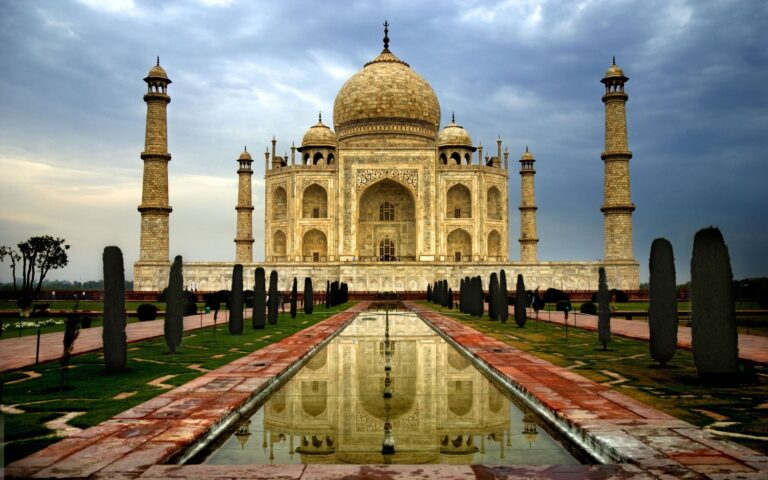
THE TAJ MAHAL — A PALACE OF SHIVA THAT HISTORY REFUSES TO REMEMBER

This chapter explores the controversial and compelling possibility that the Taj Mahal was originally a Shiva temple known as “Tejo Mahalaya.” The author presents architectural, inscriptional, and historical evidence that challenges the mainstream narrative of the monument as a Mughal tomb.
He examines the layout of the structure, its alignment with Vedic temple architecture, and the presence of symbols and features inconsistent with Islamic design. He also cites colonial-era records, traveler accounts, and suppressed archaeological findings that suggest the Taj Mahal was repurposed rather than constructed anew.
The chapter does not offer dogma—it offers inquiry. It invites readers to question what they’ve been told, to examine the evidence, and to consider the possibility that one of India’s most iconic monuments has a forgotten dharmic origin.
This chapter is a call to remember. To restore what was erased. To let truth speak through stone.

Letter to Fellow Citizen

CHAPTER 17
THE HIDDEN TRUTH OF INDIA’S MONUMENTS — A CIVILIZATION REWRITTEN UNDER FOREIGN BOOTS

This chapter exposes how India’s sacred architecture was systematically distorted under foreign rule. The author presents evidence showing how temples were renamed as mosques, dharmic structures were misclassified as secular ruins, and entire civilizational narratives were rewritten to suit colonial and imperial agendas.
He shares field research from dozens of sites—where inscriptions were erased, idols removed, and architectural features misrepresented. The chapter also explores how British and Mughal regimes reinterpreted India’s monuments through their own lenses, stripping them of their original spiritual and cultural context.
But the truth is still visible: in the layout of sanctums, the geometry of mandalas, the orientation of entrances, and the surviving fragments of iconography. The author calls for a civilizational reclamation—not just of structures, but of meaning.
This chapter is a revelation: India’s monuments are not relics—they are records. And they are ready to speak again.

Letter to Fellow Citizen

CHAPTER 16
THE HUMAN STORY — A THEORY BUILT ON GUESSWORK, NOT TRUTH

This chapter challenges the conventional narrative of human evolution and migration. The author argues that much of the “official” human story is based on fragments, interpretations, and speculative timelines rather than solid evidence. He highlights how missing fossils, contradictory findings, and shifting theories expose the uncertainty behind widely accepted models.
The chapter also examines how Western academia constructed a linear, Euro‑centric version of human history—often ignoring ancient civilizations like Bharat that preserved memory, philosophy, and continuity far older than archaeological estimates. The author calls for a more honest, multidimensional understanding of human origins—one that respects ancient knowledge systems, questions scientific dogma, and embraces evidence beyond the narrow lens of colonial anthropology.
This chapter is an invitation to rethink everything we assume about where humanity began, how it evolved, and what truths have been overlooked.

Letter to Fellow Citizen

CHAPTER 15
THE ARYAN INVASION THEORY — A COLONIAL LIE THAT CRUSHED A CIVILIZATION’S SELF-RESPECT

This chapter dismantles one of the most damaging myths in Indian history: the Aryan Invasion Theory. The author explains how this theory was invented by colonial scholars to justify British rule, divide Indian society, and erase Bharat’s indigenous genius.
He presents linguistic, archaeological, and genetic evidence that disproves the idea of an “Aryan race” invading India around 1500 BCE. Instead, the chapter affirms the continuity of Indian civilization from the Saraswati-Sindhu era through the Vedic age and beyond.
The author also explores how this lie was institutionalized in textbooks, media, and academia—creating deep psychological wounds and civilizational confusion. He calls for a complete rejection of this colonial narrative and a restoration of India’s true history.
This chapter is not just a correction—it is a liberation. A reclaiming of pride, unity, and truth.

Letter to Fellow Citizen

CHAPTER 14
JESUS IN INDIA — A JOURNEY I WALKED WITH MY OWN FEET

This chapter recounts the author’s personal pilgrimage to uncover the possibility that Jesus spent time in India. It is not based on speculation—it is based on travel, study, and direct experience. The author visited monasteries, archives, and sacred sites across Ladakh, Kashmir, and Himachal Pradesh, tracing legends and records that suggest Jesus may have lived and taught in Bharat.
He reflects on manuscripts that mention “Issa,” oral traditions preserved by monks, and the striking philosophical parallels between Jesus’s teachings and ancient Indian wisdom. The journey was not just physical—it was emotional, spiritual, and civilizational.
The chapter does not claim to rewrite theology. It invites readers to explore a forgotten chapter of spiritual history—one that could unite East and West in deeper understanding.
This is a chapter of footprints. Of silence. Of sacred possibility.

Letter to Fellow Citizen

CHAPTER 13
ABRAHAM’S ROOTS IN INDIA — A DISCOVERY THAT SHOOK ME

This chapter explores a startling possibility: that Abraham—the patriarch of Judaism, Christianity, and Islam—may have civilizational roots in India. The author shares linguistic parallels, cultural echoes, and historical anomalies that suggest a deeper connection between ancient Bharat and the Abrahamic tradition.
He examines the etymology of the name “Abraham,” its resonance with Sanskrit terms like “Brahma,” and the geographic clues that point eastward. He reflects on ancient trade routes, shared symbols, and the possibility of cultural transmission long before the rise of the Middle East’s dominant religions.
The chapter does not claim certainty—it invites inquiry. It presents this discovery not as dogma, but as a doorway to deeper civilizational understanding. The author urges scholars, seekers, and spiritual leaders to explore these links with humility and openness.
This chapter is a moment of awe. A reminder that history is not fixed—it is waiting to be rediscovered.

Letter to Fellow Citizen

CHAPTER 12
VEDIC CIVILIZATION — THE MOTHER OF ALL CIVILIZATIONS

This chapter makes a bold and evidence-backed claim: the Vedic Civilization of Bharat is the oldest and most foundational civilization in human history. The author presents archaeological, linguistic, astronomical, and ecological evidence to show that the Vedic worldview predates and surpasses other ancient cultures in depth and continuity.
The chapter explores the sophistication of Vedic thought—its understanding of time, cosmos, ecology, and consciousness. It contrasts this with the fragmented, materialist frameworks of other civilizations and shows how the Vedic tradition offered a holistic, dharmic model of life.
The author also critiques the colonial and Western academic tendency to dismiss or distort Vedic history. He calls for a civilizational reawakening that places Bharat at the center of global history—not out of pride, but out of truth.
This chapter is a declaration: the Vedic Civilization is not just India’s heritage—it is humanity’s origin story.

Letter to Fellow Citizen

CHAPTER 11
SANSKRIT — THE MOTHER OF LANGUAGES, THE SCIENCE OF CIVILIZATION

This chapter explores Sanskrit not merely as a classical language, but as the foundational science of Bharat’s civilization. The author explains how Sanskrit encoded philosophy, mathematics, astronomy, medicine, and governance—making it a civilizational operating system rather than just a medium of speech.
The chapter traces Sanskrit’s influence across Asia and Europe, showing how its grammar inspired linguistic systems and its vocabulary seeded many modern tongues. It challenges the colonial narrative that Sanskrit is “dead” or “elitist,” and instead presents it as a living, logical, and universal framework.
The author also reflects on how Sanskrit’s decline was engineered—through colonial education, distorted history, and cultural neglect. He calls for a revival not just in temples and universities, but in everyday life, education, and governance.
This chapter is both a tribute and a manifesto: Sanskrit is Bharat’s soul-script. To reclaim our civilization, we must reclaim its language.

Letter to Fellow Citizen

CHAPTER 10
THE EVIDENCE OF A LIFETIME — A CIVILIZATION REVEALED

This chapter presents the culmination of the author’s decades-long research into Bharat’s civilizational truth. It draws from 35 years of travel, study, and documentation—across India and 60 other countries—to reveal a vast body of evidence that affirms India’s ancient continuity, ecological wisdom, and philosophical depth.
The author shares how he visited temples, libraries, archaeological sites, and sacred landscapes, often documenting inscriptions, manuscripts, and oral traditions that mainstream history ignores. He describes how this evidence—photographs, field notes, maps, and texts—forms the foundation of this book and the civilizational movement it seeks to inspire.
The chapter is not just a list of findings—it is a revelation. It shows how Bharat’s story has been buried under colonial distortions and how truth, once uncovered, demands action.
This is the chapter where research becomes testimony. A civilization long denied begins to speak.

Letter to Fellow Citizen

CHAPTER 9
A REQUEST FOR TIME — AND A VISION ROOTED IN NATURE

This chapter presents the author’s heartfelt request to the Prime Minister in 2014—not for power or recognition, but for time. Time to serve Bharat Mata through research, writing, and ecological action. The letter offered a clear vision: to correct India’s history and restore its civilizational pride through truth and nature.
The author outlines how his environmental mission and historical research are not separate—they are two sides of the same dharmic service. He describes a vision where India’s revival must be rooted in ecological harmony, cultural continuity, and truthful education.
The chapter includes excerpts from the original letter and reflects on the silence that followed—not as rejection, but as a reminder that such service must begin from within.
This chapter is a blend of personal resolve and national vision—a call to serve without expectation, and to heal Bharat through truth and nature.

Letter to Fellow Citizen

CHAPTER 8
TRUTH MUST RETURN — INDIA’S HISTORY IS THE WORLD’S HISTORY

This chapter presents one of the book’s boldest claims: that correcting India’s history is not just a national duty—it is a global necessity. The author argues that Bharat’s civilizational timeline predates and intersects with many of the world’s so-called “ancient” cultures, and that acknowledging this truth will reshape global historical narratives.
Drawing on archaeological evidence, linguistic continuity, and cultural diffusion, the chapter shows how India’s influence reached Mesopotamia, Egypt, Greece, and beyond. It challenges Eurocentric timelines and calls for a re-centering of Bharat in the story of human civilization.
The author emphasizes that this is not a political or emotional claim—it is a scholarly, evidence-based correction. He urges historians, educators, and citizens worldwide to embrace a more accurate, inclusive, and respectful view of history.
This chapter is a call for global humility—and for India to rise not in arrogance, but in truth.

Letter to Fellow Citizen

CHAPTER 7
A THOUSAND PAGES OF TRUTH

This chapter is a passionate appeal to reform India’s history education. The author exposes how textbooks continue to teach colonial distortions, glorify invaders, and erase Bharat’s civilizational continuity. He argues that this is not just an academic failure—it is a betrayal of India’s children.
The chapter outlines key distortions: the Aryan Invasion myth, the minimization of ancient Indian science, the glorification of Mughal and British rule, and the erasure of indigenous resistance. It explains how these narratives were designed to break India’s self-respect and how they continue to shape young minds today.
The author calls for a complete overhaul of history education—rooted in evidence, chronology, and pride. He urges citizens to demand change, support truthful scholarship, and teach their children what textbooks hide.
This chapter is not just a critique—it is a manifesto for educational awakening.

Letter to Fellow Citizen

CHAPTER 6
MY OATH OF SELFLESS SERVICE TO MOTHER INDIA

This chapter marks a turning point in the author’s journey—from environmentalist and entrepreneur to civilizational servant. After decades of work in business and ecology, he felt a deeper calling: to dedicate himself fully to restoring Bharat’s true history and civilizational pride.
He describes how he gave up his flourishing enterprises, stepped away from Green Mall, and chose a life of solitude and research. This was not a retirement—it was a vow. A conscious decision to serve Bharat Mata without seeking position, money, or fame.
The chapter reflects on the spiritual and emotional depth of this oath. It was made not to any institution, but to the soul of India. It was rooted in reverence, responsibility, and a desire to awaken citizens to their forgotten heritage.
This chapter is not a biography—it is a declaration. A moment of surrender that became the foundation of a lifelong mission.

Letter to Fellow Citizen

CHAPTER 5
TWO THOUSAND YEARS OF WOUNDS — TO INDIA’S HISTORY

This chapter offers a sweeping reflection on the deep wounds inflicted upon India’s civilizational narrative over the past two millennia. The author describes how foreign invasions, colonial rule, and deliberate distortions have systematically erased, rewritten, and diminished the truth of Bharat’s history.
From the destruction of temples and libraries to the fabrication of false theories like the Aryan Invasion, the chapter outlines how India’s self-respect was attacked not only physically but intellectually. It explains how colonial historians, administrators, and even post-independence systems continued to perpetuate these wounds—often for political convenience or ideological control.
The author emphasizes that these wounds are not just historical—they are psychological and cultural. They affect how Indians see themselves, how children are taught, and how the world perceives Bharat. The chapter calls for a civilizational healing rooted in truth, evidence, and courage.

Letter to Fellow Citizen

CHAPTER 4
AN ERA CHANGER CHOSEN BY DESTINY

This chapter reflects on the extraordinary moment of 2014, when the author felt that India was not merely electing a leader but witnessing a civilizational turning point. The words “Era Changer Yug Purush” in the 2014 letter were not written out of emotion or political enthusiasm—they emerged from a deep spiritual intuition shaped by decades of civilizational study.
The author describes how, during his travels through ancient temples, forgotten shrines, and sacred geographies, he often sensed the silent presence of history itself—a presence that reveals direction to those who listen. In early 2014, that presence conveyed a message: a new epoch was beginning, and a leader chosen by destiny would carry the weight of India’s civilizational wounds.
The chapter draws parallels with Bharat’s ancient tradition, where divine timing has repeatedly placed transformative figures—sages, warriors, teachers—at crucial moments. The author felt that Narendra Modi’s rise was part of that continuum, not as a reincarnation or comparison, but as a modern expression of an ancient responsibility.
This chapter is not political commentary. It is a reflection on destiny, intuition, and the spiritual undercurrent that has guided Bharat for millennia.

Letter to Fellow Citizen

CHAPTER 3
THE FAREWELL THAT MARKED A BEGINNING (2013–14)

This chapter reveals the deeply personal decision that preceded the May 2014 letter. In late 2013, Dinesh Chandra Rawat stood at a crossroads: continue leading Green Mall, his flourishing environmental mission, or answer a higher call to serve Bharat Mata by writing the truth of India’s civilization.
He chose the latter.
He stepped away from daily operations, handed over Green Mall to his children, and moved to Mount Abu for silence, meditation, and writing. The chapter includes a farewell letter from his children, honoring his journey and explaining his transition.
This farewell was not a retreat—it was a turning point. It marked the beginning of a mission to uncover buried truths, challenge colonial distortions, and awaken civilizational pride.

Letter to Fellow Citizen

CHAPTER 2
THE LETTER THAT STARTED IT ALL — MAY 2014

This chapter presents the pivotal moment when the author, Dinesh Chandra Rawat, formally offered his decades of civilizational research to the newly elected Prime Minister of India in May 2014. The letter, written in English and Hindi, was sent by post and hand-delivered to the PMO.
It carried no personal request—only a call to correct the distortions in India’s history, to restore pride in Bharat’s civilizational legacy, and to initiate a national effort for historical truth. The author offered his service without expectation of position, money, or recognition.
Though the letter received no meaningful response, it became the foundation of this book. The chapter includes both versions of the letter, unedited and unaltered, and reflects on the silence that followed—not as a disappointment, but as a deeper realization: that civilizational correction is not the job of one leader, but the duty of every awakened citizen.

Letter to Fellow Citizen

CHAPTER 1
FELLOW CITIZENS — WHY I HAD TO WRITE THIS BOOK

This chapter opens the heart of the book. Dinesh Chandra Rawat shares how a quiet inner voice guided him for 35 years to uncover truths buried under colonial distortions. Through travel, research, and dialogue with scholars, monks, and villagers, he pieced together a vast picture of Bharat’s civilizational continuity.
In 2013–14, he made a life-altering decision: to pause his flourishing environmental mission at Green Mall and move to Mount Abu for silence, meditation, and writing. The chapter recounts how the historic election of May 2014 inspired hope, and how he submitted a letter to the Prime Minister offering his research and service.
But when no response came, he realized that correcting India’s history is not the job of one leader—it is the duty of every awakened citizen. The chapter ends with a powerful call: this book is not just a book, but a mission to restore pride, truth, and civilizational clarity.

Letter to Fellow Citizen

A Personal Massage
Born from Silence, Written for Awakening

This opening section of A Letter to Fellow Citizens introduces the spirit behind the book. It was shaped not by ambition, but by decades of quiet research, travel, and reflection. The Preface explains why this work had to be written, why it matters today, and why it is addressed directly to the citizens of Bharat.
Here you will find the author’s personal journey, the civilizational questions that guided him, and the purpose that transformed silence into a mission.